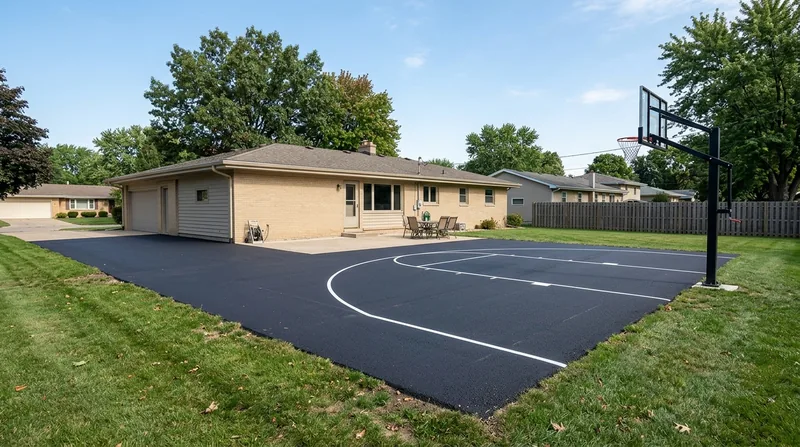




Sports Court & Path Paving in Peoria requires a foundation built to survive the freeze-thaw cycles that dominate Central Illinois winters and the shifting loess and glacial till soils beneath Peoria's neighborhoods. Backyard basketball courts, tennis courts, and recreational paths sink, crack, and heave when the base is not properly compacted or when drainage fails under the 36-inch frost line that runs through Tazewell and Woodford counties. From the bluff-top streets near downtown Peoria to the wider, flatter ranch-ring subdivisions built for Caterpillar-era families, a court that plays flat through the spring thaw requires expert grading, stable compaction, and a hot mix asphalt or sport surface laid over a base engineered for the climate. We grade and compact a base resistant to soil movement, then lay the playing surface so your court stays true through the next freeze cycle and for years beyond.
Why Sports Court & Path Paving Matters in Peoria: Frost Heave and Base Failure
Peoria's climate and soil profile create two dominant failure modes for outdoor courts and paths. On the bluffs and in older neighborhoods, loess (windblown silt) shifts and settles under freeze-thaw cycles, pushing up and cracking any court built on an unprepared base. On the till plains to the west and south, heavier glacial clay holds water against the base, and without proper compaction and drainage, that water freezes, expands, and heaves the surface. A court built with a thin or poorly compacted base fails within one or two winters; one built with a stable, well-drained foundation holds its playing surface year after year.
- We remove existing topsoil and unstable material to reach stable subgrade.
- We compact base rock in lifts to create a stable, load-bearing platform that resists frost heave.
- We grade and slope the base to shed water away from the court and into proper drainage.
- We lay hot mix asphalt or a sport-specific surface over the compacted base for a flat, playable court.
- We finish edges and aprons so water drains away from the playing surface.
A court built this way plays flat and safe, and it holds up through Peoria's winters and the heavy use that comes with family recreation and neighborhood games.
Local example: A residential court in Morton or Washington built on compacted base and proper drainage stays playable through the thaw; one built on shallow base or poor drainage develops alligator cracking and soft spots by spring. The difference is the work below the surface.
For more on how base preparation prevents common asphalt failures, see our asphalt driveway paving page, where the same principles apply to residential surfaces.
How We Build a Sports Court & Path in Peoria: Process and Site Preparation
Every court starts with the ground. We begin with a site visit to assess soil type, existing drainage, and the slope of the land. Peoria's mix of loess on the bluffs and till on the plains means each site needs a tailored approach to base preparation. We remove topsoil and any unstable material, then bring in compacted base rock, proof-roll the surface to verify stability, and establish proper drainage before any asphalt is laid.
- We measure the site and stake out the court boundaries to match your design.
- We excavate and remove topsoil and soft material down to stable subgrade.
- We import and compact base rock in 4 to 6 inch lifts, using a plate compactor or vibratory roller.
- We proof-roll the base to verify it will not settle under the weight of play and equipment.
- We establish slope and drainage to shed water away from the court surface.
- We lay the hot mix asphalt or sport surface in two lifts, binder course and finish course.
- We finish edges, aprons, and any pathways with the same care as the court itself.
The result is a court that stays flat, drains well, and plays safe through freeze-thaw cycles and heavy use.
Peoria example: A residential court in Peoria Heights or near Bradley University requires stable base on clay-rich glacial till; one on the bluff near downtown requires careful grading to handle the loess and the pitch of the slope. We adjust depth and compaction for the soil type and terrain.
Learn more about our grading and base preparation services for additional context on how we handle Peoria's challenging soils.
Sports Court & Path Paving Methods in Peoria
| Approach | Description | Best for |
|---|---|---|
| Hot Mix Asphalt Court | Two-lift asphalt (binder and finish) over compacted base rock, with proper slope and drainage. | Basketball, tennis, or general recreational courts; durable, playable, and cost-effective for Peoria's freeze-thaw climate. |
| Sport-Specific Surface | Specialty acrylic or cushioned overlay applied over asphalt for enhanced ball response and player comfort. | Tennis courts or high-use recreational courts where player safety and performance justify the additional cost. |
| Asphalt Pathway | Single or two-lift asphalt over compacted base, with proper drainage and edge definition. | Recreational paths, walking trails, or connecting routes between courts; simpler than a full court but requires the same base care. |
| Recycled Asphalt Millings Base | Compacted recycled asphalt used as base material, with new asphalt laid on top for cost savings. | Budget-conscious projects in Peoria and surrounding areas; reduces material cost while maintaining a stable, proven base. |
Sports Court & Path Paving Cost in Peoria: What to Expect
The cost of a sports court or recreational path in Peoria depends on the court size, soil conditions, base preparation depth, and the type of surface finish. A standard residential basketball or tennis court typically runs from $8,500 to $15,000 or more, depending on whether you are starting from bare ground or upgrading an existing surface. Pathways and smaller courts cost less; larger or multi-court projects cost more. Several factors move the price: the depth and complexity of base preparation needed for your soil type (loess on the bluffs requires different handling than till on the plains), the size of the court or path, access for equipment, and whether you choose a standard asphalt finish or a sport-specific overlay.
We recommend getting a free on-site estimate so we can assess your soil, slope, and drainage needs and give you a realistic price for your specific project. See our full pricing overview for additional cost context and examples across our service range.
Sports Court & Path Paving Near Me: What Peoria Homeowners Should Know When Hiring
When you are ready to build or repair a court or path, ask any contractor for proof of insurance and verify that they carry coverage for the scope of work you need. In Illinois, contractor licensing is handled at the municipal level, not the state level, so check with your city or village to confirm whether a paving contractor license or registration is required in your jurisdiction before you hire. Many Peoria-area communities do require local registration or licensing; others do not. If your court is in an HOA or a master-planned community, check with the HOA architectural committee or rules document to confirm that asphalt is an approved material and that any design or color restrictions apply. If your project involves a utility line or a culvert, Illinois law requires a free utility locate through 811 before any excavation begins.
- Request a written estimate that includes the base depth, tonnage of asphalt, and the scope of grading and compaction work.
- Ask for references from courts or paths built in Peoria or nearby communities within the last two to three years.
- Confirm that the contractor is fully insured and will provide a certificate of insurance before work begins.
- Verify that your city or village does or does not require a paving contractor license, and ask the contractor to show proof of compliance.
- Check your HOA rules or architectural guidelines to confirm asphalt is approved and to understand any design restrictions.
- Call 811 or visit call811.com at least three business days before excavation begins to request a free utility locate.
A contractor who provides a detailed written estimate, clear references, proof of insurance, and honest guidance on local permitting and HOA rules is the professional choice for a court or path that will serve your family for years.
Call us at (309) 271-2274 for a free estimate, or visit our contact page to request a consultation. We have served Peoria and surrounding communities since 2012.
Sports Court & Path Paving in Peoria: Pricing Guide
| Service | Price | Details |
|---|---|---|
| Residential Basketball or Tennis Court | Starting at $8,500 | Includes base preparation, compaction, and two-lift asphalt on a standard-size court with proper drainage and slope. |
| Recreational Path or Walkway | Starting at $4,200 | Includes site grading, compacted base, and asphalt surface for a typical residential pathway connecting structures or areas. |
| Sport-Specific Surface Overlay | Starting at $3,500 | Acrylic or cushioned sport finish applied over existing asphalt for enhanced performance and player comfort. |
| Multi-Court or Large Project | On estimate | Larger courts, multiple surfaces, or complex site conditions require an on-site assessment to provide an accurate price. |
| Travel and Estimate | Included and Free | No mileage fee within Peoria and surrounding communities; free estimate within 24 hours at (309) 271-2274. |
Indicative pricing, the exact cost depends on square footage, finish, and site access. Free personalized estimate within 24h at (309) 271-2274.


